7 Surprising Ways Animal Collective Behavior Helps Students Understand Social Media
Every evening, thousands of starlings gather into swirling murmurations, moving through the sky as if they share a single mind. A sudden turn by one bird ripples through the flock in seconds. Similar patterns appear in schools of fish, colonies of ants, migrating caribou, and countless other animal groups.
Scientists call these phenomena collective behavior – the coordinated actions that emerge when individuals interact with one another. Collective behavior is one of the most fascinating subjects in biology because it reveals how complex systems can arise without central control.
Surprisingly, the same ideas can help us understand social media. By studying these systems, scientists have uncovered fundamental principles of emergence, collective behavior, and information flow that help explain everything from fish schools and bird flocks to viral trends on social media.
Explore 7 surprising ways animal flocks empower student understanding of social media:
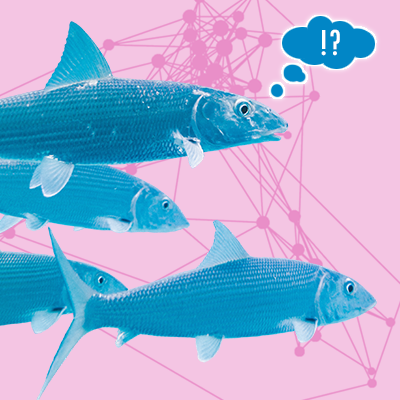
A reconstruction of the social network of a school of fish (Rosenthal et al. 2015).
1. Animal collective behavior makes social networks visible
Social media platforms – including TikTok, Instagram, and Facebook – connect us to each other. These platforms have rapidly grown to be enormous and globe-spanning, with around 2-3 billion active users every month. Because these social networks are so incredibly large, and because the algorithms underlying these platforms are obscure and ever-changing, it can be very hard to understand how and why certain trends become popular. Some trends are harmless (fashion, dances, music), but others can be dangerous (Tide Pod challenge, Chromebook challenge, anti-vaccination misinformation).
Although these systems shape our daily lives, they can be difficult to understand because the underlying networks are largely invisible. Animal groups provide a powerful window into these hidden processes.
Emergence in fish schooling.
Like humans, many animals are also connected in a social network. As a fish school swims across a lake, or a bird flock flies overhead, each individual in the group is paying attention to the movements of her near neighbors. Scientists are able to reconstruct the invisible social connections binding these animals to each other and explore them using computer simulations. Animal flocks give scientists – and students – an important way to clearly observe the structure and dynamics of social networks.
As an Assistant Professor at the University of Massachusetts—Boston doing research on animal social networks, I find that folks I talk to are super curious about my work, but aren’t at all aware about how far we’ve progressed in our knowledge of emergent behavior in animals. I worked with Galactic Polymath for many months to create the free "Animal Collective" unit to give high school and early college students a window into this rich field of research that connects to our daily lives.
2. Collective behavior is all around us
Social animals live all around us, providing countless opportunities to observe collective behavior in action. Within, below, and above the bustling activities of humans are social behaviors of a different kind – crows call to each other when they discover food, raccoons follow particular paths around the neighborhood at night, and ants trace complex trails across the sidewalk. In fact, most urban wildlife is social. All it takes to observe animal groups is to take a stroll to your local park, subway station, or even front yard. Train your senses to detect the ways in which these animals communicate with each other, and the social networks connecting these animals to each other – spanning blocks, neighborhoods, or even the whole city – will reveal themselves!
The "Group living is complex! A social network drawing activity" (Lesson 1) in the Animal Collective unit helps students consider how scientists study this complexity in nature.
Social animals live all around us, providing countless opportunities to observe collective behavior in action.
A living bridge made of army ants (Chris Reid).
3. Emergence: how simple interactions create complex systems
Ants are quite simple individually, with a limited capacity to sense the world and think. But the combined efforts of many ants can produce startling patterns that even the ants are unaware of! For example, army ants can link their legs together to form “living bridges,” which create shortcuts in the foraging trail and allow their sisters to more quickly bring food back home. However, individual ants have no sense of the greater purpose that the bridge is serving – they are just following a set of simple rules that they are “programmed” to do.
The "Emergence in the Game of Life" lesson (Lesson 2) demonstrates how complexity can arise from simple rules, as seen in emergent patterns.
This is an example of “emergence,” or the large-scale patterns that can form from many individual interactions. Emergent patterns are greater than the sum of their parts.
Social media provides familiar examples of emergence. No single person decides which videos become viral, which phrases become memes, or which ideas dominate online conversations. Instead, these patterns emerge from millions of individual interactions taking place across a social network. Studying emergence in animal groups helps students recognize similar processes unfolding in human social systems every day.
These patterns can be helpful, like the living bridges, or they can be harmful, like stock market crashes. Either way, it is important for us to recognize how our individual actions can contribute to much larger patterns, often even without our knowing it.
4. Animal groups reveal many forms of communication and influence
All kinds of animals are social, including insects, birds, fish, and mammals. There is even growing evidence that plants can communicate with each other through chemicals and other ways! The groups that exist are as diverse as the animals who make them up, from ant colonies containing millions of workers to primate groups with sophisticated social hierarchies.
Learning about all of the different ways that animals form groups forces us to break out of our preconceived notions as humans of what a social group “should” look like. We are used to particular social structures (families, communities, schools) and particular ways of communicating (spoken language, body language, emojis).
Studying the groups that other animal species form expands our horizons and shows us alternative ways that social behavior can be. For example, large herds of caribou have to decide every year where and when to migrate – how can they reach a decision together without sophisticated language? These kinds of groups give us clues about how information can flow between individuals, and how they can influence each other’s opinions.
5. Collective behavior inspires curiosity and wonder
A murmuration of starlings (National Geographic).
When we open a social media app, we get to see only a tiny piece of the social network at a time. But by stepping out in nature, we are often greeted with the elegant and beautiful movements of entire animal social networks. Thousands of starlings fly together in a mesmerizing pattern, Canada geese migrate in a V-formation, and fireflies may light up your backyard in the evenings.
Watching the acrobatics of these social animals and these remarkable examples of collective behavior, it’s hard not to feel wonder about them. How can they achieve such incredible coordination? In fact, as recently as 100 years ago, the ornithologist Edmund Selous believed that birds must be able to read each other’s minds (“thought waves”) – it was the only explanation that he could think of to explain how flocks could move so elegantly together. We now know that birds don’t need to read minds, but the feeling of awe remains.
The "Swimming in the Dark" lesson (Lesson 4) in the "Animal Collective" unit allows students to use a custom simulation to run digital experiments about fish schooling behavior, deepening their understanding of this coordination.
6. Collective behavior can create collective intelligence
Animals live in groups not because it feels good but because it helps them to survive – an essential goal of all living things! This means that being social provides benefits to the individuals in the group. One major benefit of sociality is that it helps animals keep safe from predators by joining forces to attack the approaching threat. Another benefit is finding food – with many more eyes looking for food, the odds are high that at least one member of the group will detect a new food source.
Scientists often describe these advantages as forms of collective intelligence – the ability of groups to solve problems, share information, and make decisions more effectively than individuals acting alone.
Social media and other forms of social behavior can also help us. We learn new skills and information from each other, and we support each other in times of need. But it can also be harmful, leading to the spread of false information, more extreme viewpoints, and greater isolation. What can we learn from animals to make our social interactions more productive, more helpful, and more unifying?
The "Emergence in Human Social Networks" (Lesson 5) within the "Animal Collective" unit explores how individual choices affect the flow of information.
What can we learn from animals to make our social interactions more productive, more helpful, and more unifying?
7. We are animals, too!
We may think of ourselves as highly sophisticated creatures, with rich language, advanced technology, and rational thinking. In many ways, we are. But we are also still animals, just one of many social species on Earth. And today, we are faced with many societal challenges. Despite social media networks spanning the globe, we are more divided and less cooperative. Despite having access to all of humankind’s knowledge in our pockets, we are less informed. Perhaps we aren’t quite as smart as we think we are.
The good news is that we have the capacity to change our social interactions! We can design new social media platforms and engineer new algorithms for how information is shared. Rather than invent these from scratch, we can borrow ideas that Nature has already invented over millions of years of evolution. By learning about other social animals and how they successfully cooperate with each other, we can use “bioinspiration” to fast-track the development of social media that is actually good for us. Comparing existing social media with animal groups lets students understand more clearly what works and what doesn’t and brainstorm ways that we might be able to make things better.
To really get social media, it’s helpful to see the bigger picture. We designed the "Animal Collective" unit to do just that—through hands-on activities, simulations, reflection, and discussion. It'll get your students thinking critically about how our individual behaviors affect the system as a whole, and maybe even help us build better online communities!
Animal Collective
How group behavior can produce surprising problems—and solutions!
 at the University of Massachusetts Boston - National Science Foundation logo](https://storage.googleapis.com/gp-cloud/lessons/AnimalCollective_en-US/NSF_logo_sm.png)
Students will draw their own social networks, ponder the meaning of complexity and begin to notice unexpected patterns that emerge around them, unnoticed. Through hands-on activities and digital experiments, students will discover how complexity research enriches our daily lives.

Frequently Asked Questions
-
Collective behavior refers to the coordinated actions that emerge when individuals interact with one another. Examples of collective behavior include bird flocks, fish schools, ant colonies, and even human social networks. Scientists study collective behavior to understand how groups can solve problems, share information, and make decisions.
-
Emergent behavior occurs when complex patterns arise from many simple interactions. No single individual controls the outcome. Instead, large-scale patterns emerge naturally from local behaviors. Examples of emergent behavior include ant bridges, bird murmurations, traffic patterns, and viral trends on social media.
-
Some of the most striking examples of emergence in nature include schools of fish moving as a coordinated group, starling murmurations, ant colonies building complex structures, and fireflies synchronizing their flashes. In each case, collective patterns emerge from interactions among individuals rather than from centralized control.
-
Animal groups help us understand how information spreads through networks. Just as information moves through a flock of birds or a school of fish, ideas and trends spread through human social networks. Studying animal groups can help students better understand social media, misinformation, influence, and collective decision-making.
-
Collective intelligence is the ability of groups to solve problems, make decisions, and share information more effectively than individuals acting alone. Animal groups often demonstrate collective intelligence when locating food, avoiding predators, or navigating long migrations.
-
Studying emergence helps students develop systems thinking skills. It encourages them to look beyond individual actions and understand how larger patterns arise in nature, society, and technology. These insights can help students better understand topics ranging from ecosystems and animal behavior to social media and online communities.