What Are Protists? A Middle School Lesson That Sparks Curiosity
Discover how protists, pond water microorganisms, and ecological interactions can spark curiosity in middle school science. Plus, explore a free NGSS-aligned lesson from Galactic Polymath.
What Are Protists? How a Single Drop of Pond Water Can Open a Whole New World
I remember my first day of student teaching in a seventh grade science class. Microscopes were set up around the classroom, along with a bucket of pond water. The task was to observe a drop of pond water and record observations.
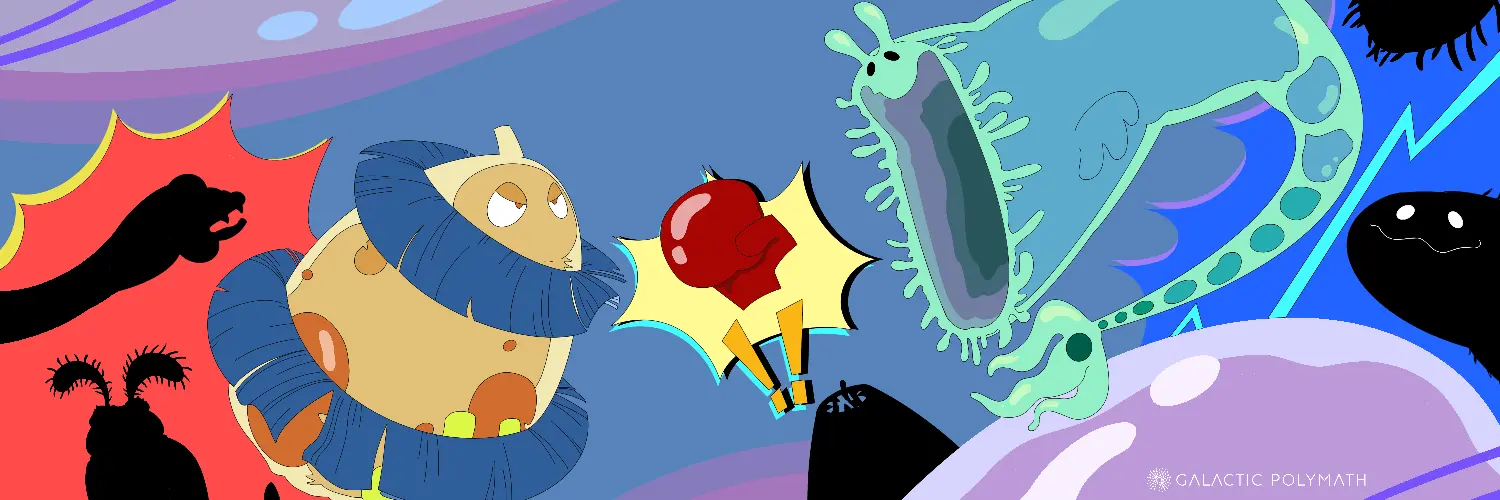
Original banner artwork by Anna Wilkins
No technology, no videos, just a microscope and the pond water, but the impact of this lesson was unforgettable. Without fail, students in every class period had the feeling of “wait, what is that?”
I thought it was one of the coolest things to witness those moments of discovery, and later when I taught about protists in my own classroom, I was able to see a replay of that excitement.
It is that same curiosity that drove the creation of the lesson called Micro Matchups: Explore ecological interactions in faceoffs between protists.
I thought it was one of the coolest things to witness those moments of discovery…
Bringing Real Scientific Research into the Classroom

Lesson tile by Anna Wilkins
My name is Laura. I am a middle school science teacher and former curriculum developer at Galactic Polymath. I love working with scientists and the GP team to deliver multimedia-rich, engaging lessons that incorporate the real research of the actual scientists we’ve been fortunate enough to team up with.
I am especially excited to be the lead writer for Micro Matchups, an awesome introductory lesson to the wonderful world of protists. We’ve collaborated with Dr. Jean Phillippe Gibert, Associate Professor of Biology at Duke University, to showcase his research on protists (You can read more about his research here).
There are a lot of amazing things I could share about Dr. Gibert, but the thing I admire most is how he talks about microorganisms in such a fun and accessible way. Dr. Gibert draws connections between common ecological interactions and how those relationships also exist at the microscopic level.
Honestly, I never really thought about drawing those parallels until Dr. Gibert pointed them out, but now it makes total sense. These connections, paired with the inevitable excitement of seeing protists for the first time, make for a much richer understanding of protists as students discover entire ecosystems do exist in a single drop of water.
Exploring Protists, Even Without Microscopes
This middle school-focused lesson is a super fun and easy way to introduce protists. It’s especially great if you do not have access to microscopes but want your students to see protists firsthand.
Micro Matchups: Round 1 (Halteria vs Lacrymaria). Who will win?!
In fact, we are lucky enough to partner with James Weiss (definitely check out his YouTube channel, the Microscopic Odyssey) to bring you some extremely detailed videos of protists being protists. His work is incredible! Alternatively, if you do have access to microscopes, this lesson could complement your planned observations of live samples.
Either way, if you are looking to pique curiosity about protists with stunning videos of microscopic matchups, have your students make predictions of the outcomes using text and data, then watch an extremely entertaining Duke researcher provide detailed commentary and research connections, and give this lesson a try. Don’t forget to share your feedback after teaching this lesson or watching the videos in the comments below.
Micro Matchups
A multimedia-rich exploration of protists


Pique curiosity about protists with stunning videos of microscopic matchups. Predict the outcomes using text and data, then watch a Duke researcher provide detailed commentary and research connections. An awesome intro to the wonderful world of protists for middle school to adults.

Frequently Asked Questions
-
Protists are mostly single-celled organisms that live in aquatic environments such as ponds, lakes, oceans, and moist soil. Although they are microscopic, protists play essential roles in ecosystems by producing oxygen, recycling nutrients, and serving as food for other organisms.
-
Protists are found almost everywhere there is water or moisture. They commonly live in pond water, lakes, streams, oceans, wetlands, and damp soil. A single drop of pond water may contain dozens of different species of microscopic organisms.
-
Under a microscope, protists come in an incredible variety of shapes and sizes. Some swim using tiny hair-like cilia, others move with whip-like flagella, and some extend flexible structures called pseudopods. Watching protists under a microscope reveals how they move, feed, and interact with one another.
-
Protists are essential to healthy ecosystems. Many produce oxygen through photosynthesis, while others help recycle nutrients or serve as food for larger organisms. Scientists also study protists to better understand ecology, evolution, and environmental change.
-
Ecological interactions describe the ways organisms affect one another. Examples include predation, competition, cooperation, and mutualism. Protists provide excellent examples of these interactions because many can be observed directly under a microscope.
-
Pond water contains a rich community of microorganisms that allow students to observe biodiversity and ecological interactions firsthand. Exploring pond water helps make abstract ecological concepts visible and memorable.
-
Studying protists introduces students to microorganisms, ecosystems, biodiversity, and ecological relationships while developing observation, evidence-based reasoning, and scientific inquiry skills. It also aligns well with middle school life science and NGSS standards.